
Sustainability has moved beyond being an aspirational concept to become a strategic criterion in both everyday decision-making and in the process of buying or investing in real estate. In this context, the Sustainable Development Goals (SDG 2030) serve as a global framework for assessing whether an urban project is aligned with a long-term, resilient, and socially responsible vision.
This article explores what the SDG 2030 are, the commitment Panama has assumed under this global agenda, and how urban developments such as Porta Norte align in concrete ways with these goals. Understanding this relationship not only provides clarity about the project itself, but also offers an advantage grounded in certainty, planning, and sustainable value.
The Sustainable Development Goals, also known as the Global Goals, were adopted by the United Nations in 2015 as part of the Agenda 2030, a universal action plan aimed at eradicating poverty, protecting the planet, and ensuring conditions of peace and prosperity for all people.
Are the goals mandatory for countries? No. However, the SDG function as a development compass, guiding public policy, private investment, and urban planning toward a balance between economic growth, social well-being, and environmental protection. They are not merely general principles, but a technical system designed to measure real and comparable progress across countries and sectors. |
The Agenda 2030 is built on a clear and measurable structure:
These goals are universal, transformative, and civilizational in nature. They apply to all countries, promote structural change in development models, and are grounded in the principle that no one should be left behind.
Panama formally adopted the Agenda 2030 in September 2015 through an Executive Decree, integrating the SDG into its national development strategy. Although the SDG do not constitute a coercive legal obligation, they represent a voluntary political commitment with both national and international scope.
Since then, the country has worked to align its National Strategic Plan with a State Vision to the 17 goals, involving public institutions, the private sector, and civil society. The Social Cabinet serves as the technical body responsible for coordinating, formulating, and evaluating public policies aligned with the SDG.
Panama has also assumed a commitment to transparency by submitting Voluntary Reports to the United Nations General Assembly, outlining progress, challenges, and priorities. In the urban realm, the country has identified SDG 11: Sustainable Cities and Communities as a key pillar for transforming territorial development, particularly in strategic growth areas such as Panama Norte.

Porta Norte has been conceived as a comprehensively planned community, designed from its inception to align with the Agenda 2030 and the SDG, with a central focus on sustainable urbanism.
The walkable city model and the integration of green areas encourage daily physical activity, improve cardiovascular health, and support mental well-being. Continuous contact with nature and public spaces promotes social interaction and reduces urban stress.
The master plan reserves space for educational institutions such as St. Peter’s Academy, with an approach that differs from the traditional model. The development promotes campuses integrated with nature, creating physical environments that enhance learning and holistic development.
The project incorporates state-of-the-art infrastructure, including underground public utilities and fiber-optic connectivity, enabling an efficient, technological, and resilient city. Porta Norte is envisioned as a smart city and startup city, capable of attracting talent, innovation, and new ways of working.
This is the structural axis of the project. Porta Norte prioritizes human-scale urbanism, with people-centered streets, wide sidewalks, public plazas, and services accessible within a five-minute walk. The model reduces reliance on automobiles and integrates residential, commercial, educational, and recreational areas into a single environment.
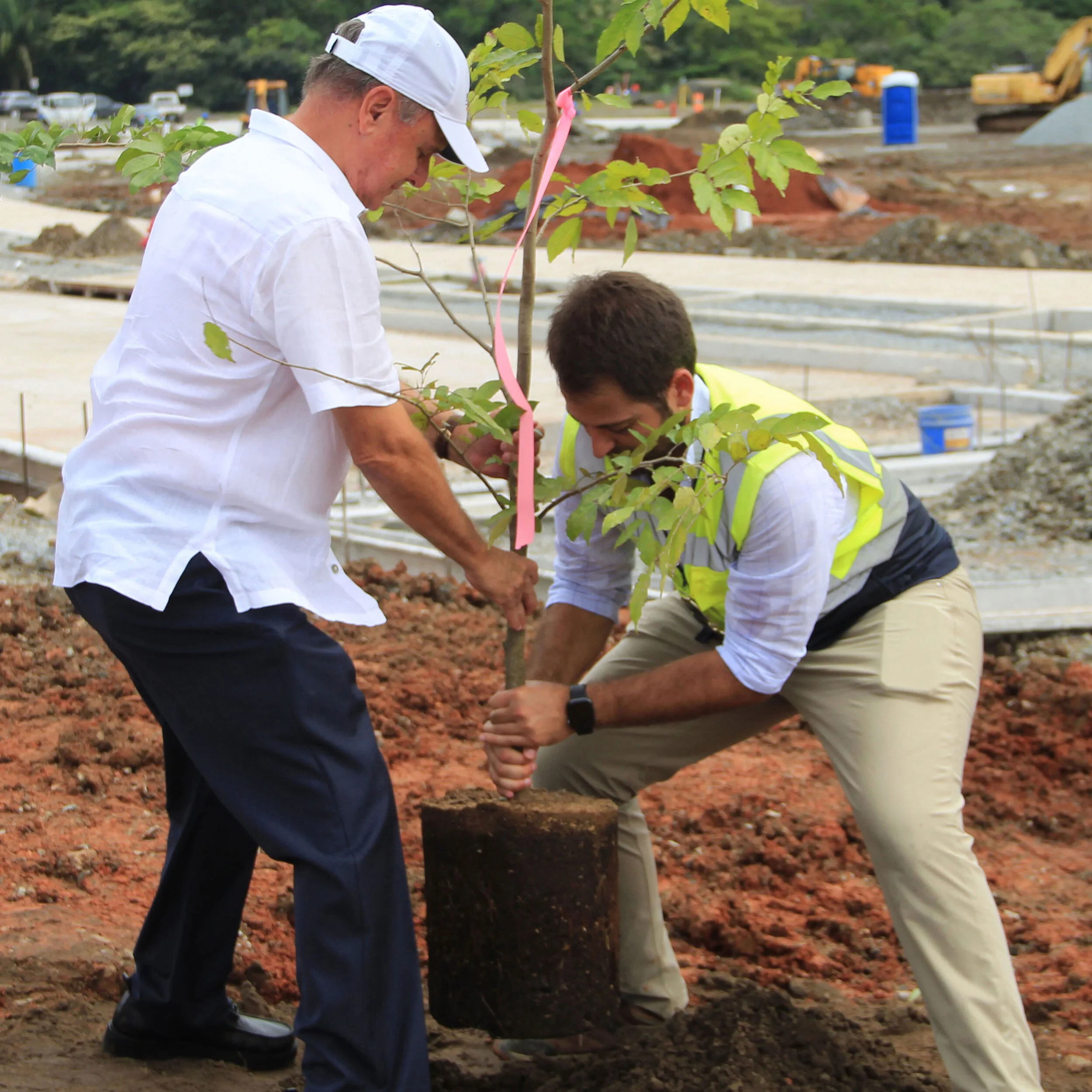
Porta Norte incorporates environmental conservation strategies from the earliest stages of urban planning. Centenary trees and natural waterways such as the María Prieta River and the Mariposa Creek are preserved, while the planting of native species is actively promoted. Zero-emissions mobility and large-scale urban forestry help mitigate the urban heat island effect and reduce emissions.
The SDG 2030 have become the common language of sustainable development worldwide. For society at large, they represent a strategic tool for identifying projects with a long-term vision, aligned with national policies and international trends.
Panama has embraced this commitment as part of its growth model, and Porta Norte exemplifies how the Agenda 2030 can be translated into a planned, resilient urban development focused on human well-being. Investing in projects aligned with the SDG means not only investing in sustainability, but also in certainty, value, and the future of humanity.